
%20(2).png)

A few years ago, I sat across from Jim, a client, friend, and business owner who'd spent three decades building a significant local business. His succession plan was always to sell internally to Carl, a hand-picked successor he had been grooming for a decade. There had been hundreds of conversations, mutual buy-in, a plan in place, and for years, everyone was moving toward the same destination.
Then, in what seemed like the ninth inning, after attorneys had drafted documents and banks had started the financing process, Carl got cold feet. He literally walked in one day and told Jim, “I just don’t think I can handle it,” and backed out.
Just like that, the deal Jim had been quietly building his retirement around was gone. He wasn't just back at square one. It was worse than square one because now he had less time, less leverage, and a successor situation that needed to be untangled before he could even think about starting over.
I share this story because it's the single best argument I have for why you should be reading this guide today instead of waiting until you're “actually ready” to sell. If you own a business and you're somewhere in your 50s or 60s, the question isn't if you'll eventually step away. It's whether you do it on your terms, with your leverage, or someone else's timeline.
Which sounds better?
Use this guide for what it is: exactly what I tell clients who are starting to think seriously about selling and the actual questions they ask me.
What's the single biggest thing that increases the value of a business before a sale?
Preparation... hands down. Not a clever deal structure, not finding the “right” buyer at the “right” time. Preparation years in advance.
Specifically, it comes down to how your entity is structured, whether you've built real systems and processes, and how dependent the business is on you personally. A business that runs without you in the room every day is worth significantly more to a buyer than one that grinds to a halt the moment you take a vacation.
I've watched high-revenue businesses get discounted heavily, or simply fail to attract serious buyers, because the whole operation lived in the owner's head.
News flash: If your business can't survive you taking three weeks off the grid, that's not a compliment to your work ethic. That's a valuation problem.
One more blunt reality: your entity structure shouldn’t just be a decision you made years ago and forgot about. It directly affects how easily your business can even be sold. A simple sole proprietorship, for instance, is often the hardest structure to sell for real money because there's no real separation between you and the business in the eyes of a buyer.
If that's your situation, it doesn't mean you can't have a great exit. It means the work of separating yourself from the business needs to start now, not the year you decide to sell.
How early should I start planning my business exit?
Earlier than feels necessary. From my experience, three years is the absolute minimum, and even then, there’s very little room for anything to go wrong. Five to seven years (or more) is genuinely better.
Here's the uncomfortable truth about timing. Earlier in the process, you hold the cards. Later, the buyer does.
In your 50s, you don’t have to sell and, therefore, can create the conditions on your terms and in the timeline you select. Owners who start early get to walk away from a bad offer or negotiate terms from a place of strength. The longer you wait, the more time works against you. The buyer gains leverage and you may not be able to afford to walk away from a less than desirable offer. All of a sudden, you’re 70 years old, wanting life to slow down, and you’re scurrying to get a deal over the finish line.
It’s also worth knowing that a meaningful share of deals that reach a signed Letter of Intent (LOI) never actually close. That's just the reality of mergers and acquisitions (M&A). The owners who weather that well are the ones who have time, options, and a fallback plan. The owners who get hurt are the ones who needed a specific deal to work because they waited too long to build alternatives.
What mistakes do business owners make most often when they start thinking about selling?
A handful, in no particular order:
- Mistake 1: Picking a number out of thin air. Do you know how many times I’ve heard, “If I could get $X for the business, I'd sell”? I always ask, “where did you come up with that number?” Almost always, it’s a shot in the dark and it's almost never tied to any sort of actual analysis of what their life will cost to fund. This is not a plan. It’s a guess, untethered to reality.
- Mistake 2: Falling in love with the gross number. The headline sale price is a vanity metric. It is not what funds your retirement. Taxes, deal costs, and fees all take a significant bite before that number becomes real money. The number that matters is what's left after all of it. Understand the net. Don’t get fixated on the gross.
- Mistake 3: Spending phased payouts like a paycheck. This one drives me nuts. When part of the deal is structured as payments over several years, I've watched sellers quietly start treating each year's payment as replacement income for the salary they used to draw. It isn't. It's principal from the sale of an asset, just as if you'd received it all in one lump sum. That money should be saved and invested like any other sale proceeds, not spent as if it's earnings. Spend it like a paycheck and you can outlive a deal that, on paper, looked like more than enough. And don’t get me started on how treating those payments as income can cause massive lifestyle creep.
- Mistake 4: Underestimating what life costs after the sale. This may be the mistake that catches people off guard more than any other. Two things happen at once, and if unprepared they’ll kick you in the teeth faster than a prairie fire with a tail wind. First, spending often goes up. More time means more travel, more hobbies, and more opportunities to say “yes” to things you once skipped because you were too busy running a company. Second, don’t forget the many expenses that quietly lived inside the business, which suddenly become personal. Your phone, car, computers, mileage, subscriptions, meals, and more all migrate onto your personal balance sheet the day you sell. People are routinely surprised by both.
- Mistake 5: Not thinking past the closing table. Owners pour enormous energy into the transaction itself and very little into what their life, purpose, and giving will look like after it closes. By the time they get around to it, some of the best tax and legacy planning windows have already shut.
- Mistake 6: Assuming the deal team has it covered. Your M&A attorney and CPA are essential, and they are the right professionals to put a great deal together. However, they are not thinking about your full financial life. Their job is to get the deal done. Nobody on that team is necessarily asking how this transaction fits into your tax picture five years from now or what you actually want life to look like after the sale. That's a different job, and it's one that's easy to assume someone else is handling when, often, no one is. This is precisely where the right Financial Advisor can play an invaluable role.
- Mistake 7: Underestimating the identity hit. For many owners, the business isn't just an asset. It's part of who they are. Losing that after the sale can hit harder than people expect. It's worth planning for the emotional side with the same seriousness you'd give the financial side. We wrote an entire white paper about this, which I encourage you to read: CPW The Unspoken Crisis
How does a buyer decide what my business is worth?
Buyers pay for what they can take over and continue growing, not for what you personally built while you were the one running it every day.
That means the things that move the needle are transferable cash flow, how sticky your customer relationships are without you, the depth of your team, and how cleanly the business operates when you're not in the building. Rules of thumb for valuation multiples exist, but serious buyers are looking past the headline number to whether the business can stand on its own.
Here's where that gets uncomfortable for many owners. Revenue multiples are a starting point, not an answer. What actually matters is the cash flow a buyer can expect once they're running things. If you're the primary producer in your business, replacing you costs money. A business doing a few million dollars in revenue, with the owner personally generating most of it, may look impressive on paper and still have surprisingly little transferable value once you account for what it costs to hire someone, or even two people, to replace what the owner was doing.
Two more things buyers do that catch owners off guard:
First, they rarely pay full face value for receivables or unbilled work. The older an invoice is, the less it's worth to them, and they'll often want protection against amounts that are never collected. Second, expect a meaningful chunk of your payout to be tied to an earnout, meaning money you’ll receive only if clients or customers actually stick around after you leave. If they walk when you do, the purchase price you thought you negotiated quietly shrinks. This is the financial version of the key-person problem. If the relationships belong to you instead of the business, you haven't built something transferable. You've built yourself a well-paying job.
This is also why well-drafted operating or shareholder agreements with clear succession provisions matter more than people realize. A clean structure on paper is part of what makes a business genuinely transferable, not just sellable in theory.
What role does tax planning play in a business sale?
A bigger one than most owners expect, and it’s one of the easiest things to get wrong by starting too late.
Whether the deal is structured as an asset sale or an equity sale matters more than most owners realize going in, and it's often a point of real tension at the negotiating table. Buyers tend to prefer asset sales because it lets them step up the tax basis on what they're buying and take bigger depreciation deductions later. Sellers tend to prefer equity sales because the proceeds are more likely to qualify for long-term capital gains treatment instead of being taxed as ordinary income. Neither side is wrong. It simply means this is something to understand early, not something to discover mid-negotiation.
Layered on top of that is how the purchase price gets allocated across different categories once a structure is agreed on. That allocation isn't just paperwork. It directly affects how much of your proceeds get taxed as capital gains versus ordinary income, which is a meaningfully different outcome depending on how the numbers land.
Pre-sale moves, like maximizing contributions to qualified retirement plans in the years leading up to a sale, can also meaningfully affect what ultimately lands in your pocket after closing. None of these decisions work well in isolation. They need to be made with a clear view of both the transaction itself and your broader tax picture over the years that follow, not just the year of the sale. And if the sale is large enough to meaningfully change your net worth, it's worth a conversation with your advisory team well before signing anything about whether more advanced estate and wealth transfer planning makes sense for your family, not just your tax return.
How does the sale of my business fit into my retirement and personal goals?
This is, honestly, where I think most owners leave the most value on the table. Not in the deal itself, but in everything around it.
A good sale gets you a number. A good plan tells you whether that number actually funds the life you want, what your spending will realistically look like once the business expenses shift onto your personal books, and how you want to spend your time, your money, and your energy once the transaction is behind you. Charitable intent, family goals, the next chapter of your identity... all of it works better when it's planned before the closing table, not after it.
The advisors who add the most value here are thinking well beyond the transaction itself, toward the actual life it's meant to support.
What should I do if I'm starting to think about this seriously?
In order, this is what I tell clients. Here's how it tends to break down (albeit very oversimplified) on a calendar:
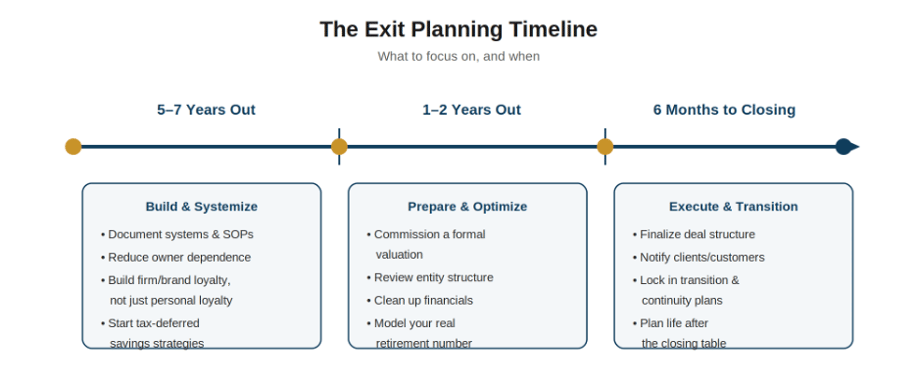
- Start earlier than feels necessary. Five to seven years out, ideally.
- Get an honest, outside perspective on what your business is actually worth and what would specifically move that number.
- Review your entity documents. Build or strengthen the systems that make the business less dependent on you personally.
- Model your actual retirement needs. Work forward from your real life, not backward from a number you picked because it sounded good.
- Build a team that covers both sides of the table: the transaction experts who get the deal done, and someone responsible for your full financial picture and the years after the deal closes.
The owners who exit on their own terms are, almost without exception, the ones who started treating their business as a transferable asset years before they actually needed it to be one.
What happened with Jim you ask? The business owner I mentioned at the start? Well, he eventually did get to a successful exit. It just took him longer, cost him more, netted him less, and produced a few extra gray hairs he didn't need.
Don't be Jim if you can help it.
Nick Murphy, CFP® is the founder of Counterweight Private Wealth, a fee-only, fiduciary wealth management firm serving high-net-worth individuals navigating significant financial transitions. Counterweight provides comprehensive financial planning, tax strategy, tax preparation, and investment management.
This article is for informational purposes only and does not constitute personalized financial, tax, or legal advice. Please consult qualified professionals regarding your specific situation.